
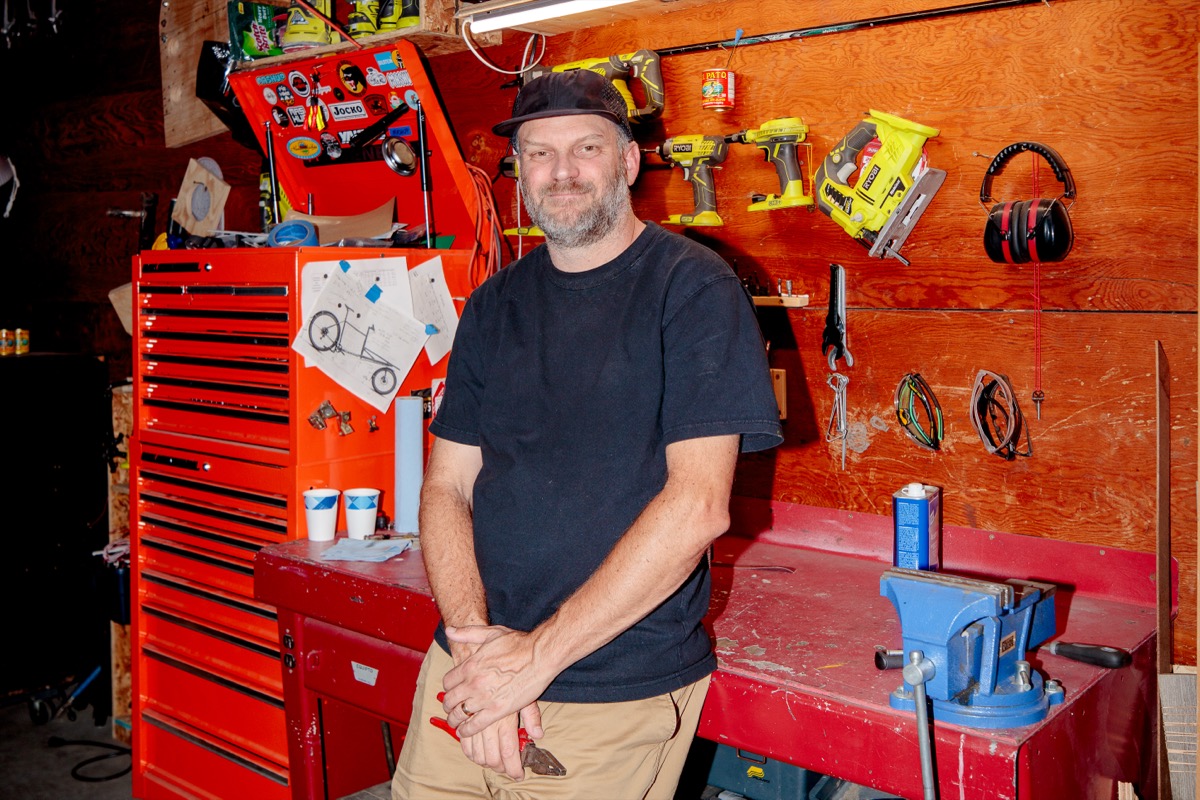
Jason Cox
Jason Cox is a Missoula, Montana based artist. He grew up in Los Alamos, New Mexico, where he imprinted on the nomadic bicycle mechanics at Trail Bound Sports and absorbed a large dose of mad scientist energy while working at Los Alamos National Laboratory.
His love for zines was forged in the basement of the Fort Lewis College library, feeding coins into the photocopier like it was Ms. Pac-Man. Jason's current work explores materials, geometry, and bicycles. He loves to trade zines.
His favorite color is plywood.
Exhibitions
Solo and two-person
- 2027My Favorite Color Is Plywood, solo show, Zootown Arts Community Center (ZACC), Missoula, MT — July–August 2027
- 2025Freak Bikes: Pedal Powered Fare and Swing Bike Rodeo, with Jesse Blumenthal, The Palace Gallery, Ellensburg, WA — July 4–26, 2025
Public sculpture
- 2026The S, oriented strand board, Missoula, MT
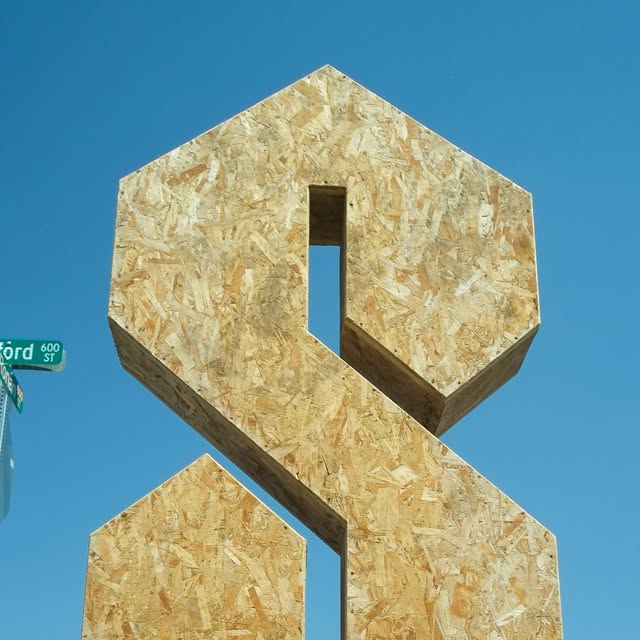
The S, 2026
Group shows and performance
- 202614th Annual Mini Show, ZACC, Missoula, MT
- 2025Interactive inflatable sculpture built from trash bags, live performance, ZEST Fest, ZACC, Missoula, MT
- 202513th Annual Mini Show, ZACC, Missoula, MT — Spoon Tetrahedron #1 and #2
- 2024Community Show, ZACC, Missoula, MT
Commissions and collaborations
- 2026Custom vintage-inspired speakers for Shapes Hi-Fi Bar, Missoula, MT — JBL woofers and Altec horns in hand-built cabinets
- 2022Built The Sun (ABS pipe, speakers, plywood) to the artist's specifications and helped wire and install Jesse Blumenthal's Endemic, Holter Museum of Art, Helena, MT
Photography
- 2026Stills, Missoula Makes Movies, The Roxy Theater's first 72-hour film festival, Missoula, MT — October 9–15, 2026
- 2026Unit stills, Runners, a short film by Cold Water Productions — published as the zine Runners
- 2024Cyclist portraits, Missoula Climate Ride — October 6, 2024
Zines — Mashup Publishing
- 2026Runners (unit stills from the Cold Water Productions short film)
- 202545 r.p.m. · Superia 2001 (with Nate Cook) · Yashica Weekend · Stereo · Ground Portal Glyphs · Pedal Powered Fare and Swing Bike Rodeo (with Jesse Blumenthal)
- 2025As publisher: Sleep Eat Weird Street by Nate Cook · Cargo Shorts: Love Notes to Meg, Vol. 1 and Goodbye Molar: Love Notes to Meg, Vol. 2 by Jane Einhorn
- 2024Portal Guide · Car Wash
- 2022Road Trip · Night Moves · Mashup, Issue 1
- 2025Built the zine display at the ZACC, where Mashup titles and work by other
local zine makers are sold on a commission split. Also sold at Slant Street Records and on
Etsy.
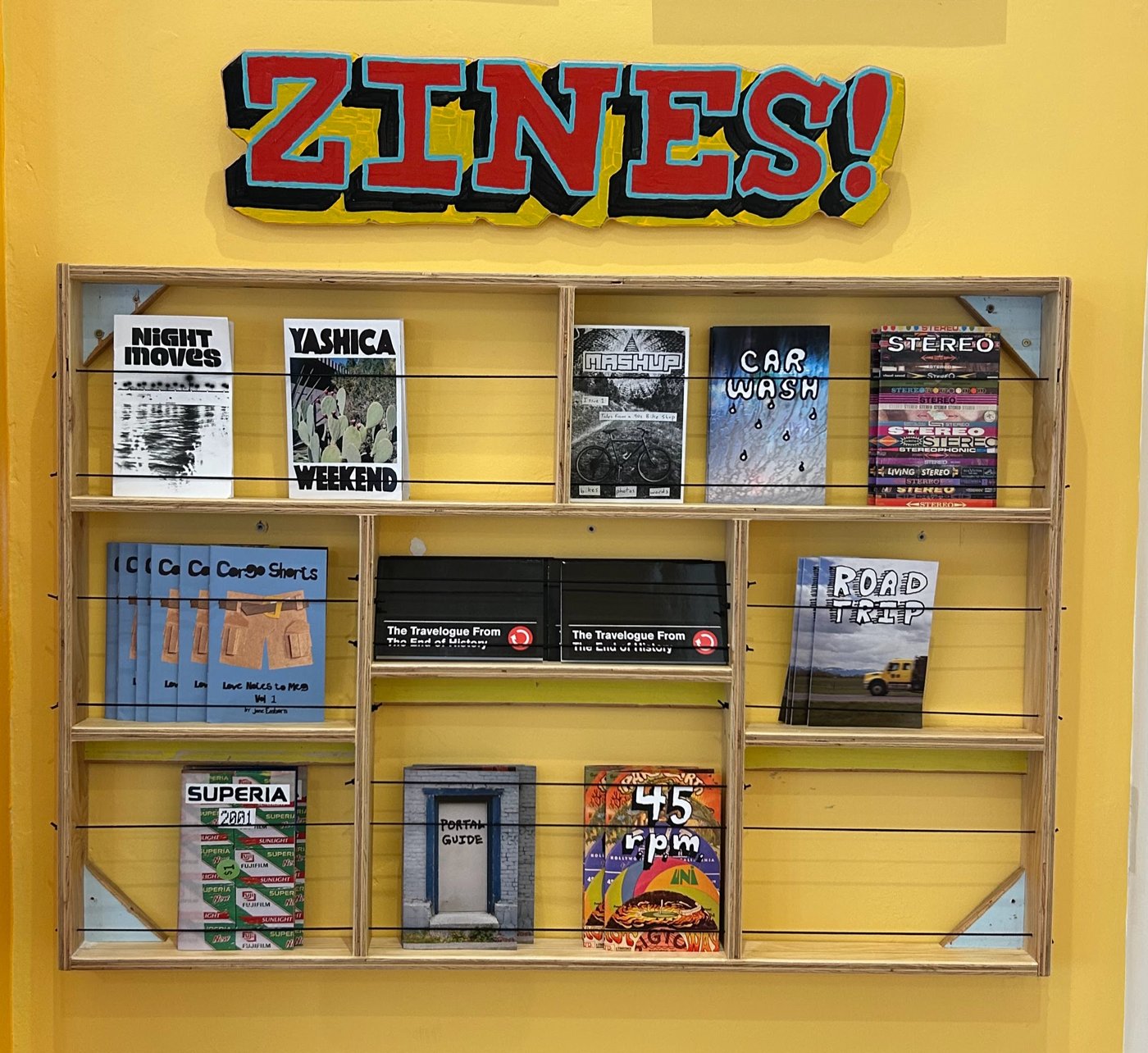
Zine display, Zootown Arts Community Center, 2025
Zine fests, talks and events
- 2026Block Party, organized by Jesse Blumenthal, Missoula, MT — hosting artist talks in my studio, including my talk on analog and digital zine making; Mashup Sound System in the sound system showcase; collaborative zine — October 31, 2026
- 2025Talk on brazing for Enlighten Me, a class led by Brimber and Tyler, at my studio, Missoula, MT
- 2025Space Mission zine launch and zine swap, Confluence Center, Missoula, MT — tabled — November 16, 2025
- 2025ABQ Zine Fest XIV, Special Collections Public Library, Albuquerque, NM — tabled with Jane Einhorn
Education
- 2003BS, Computer Science, College of Santa Fe
- 1997BA, Networked Computing and Media Theory, Fort Lewis College
Mashup
Zines I have made or collaborated on. Photos, art, bikes, nerd stuff. If you have a zine I would love to trade!
A free zine imposer. Drop in your page images and get a print-ready PDF in saddle-stitch order — spreads that span the fold, borders that fit your printer — then fold, staple, done. Runs in your browser.
Bikes I build: freak bikes, swing bikes and other pedal-powered machines.
A dub sound system: horn-loaded bass scoops, spring reverb and echo, mixed live.
Projects
Low-power local-access television. A fleet of always-on art-object players showing one shared, clock-driven channel of restored public-domain film — like cable, with no transmitter.
An honest encyclopedia of vintage technology — audio, cameras, synthesizers — with specific, enthusiast write-ups of classic gear.
An encyclopedia of vintage and obsolete computing — the machines, the media, and the strange edges of the Y2K era.
Steerable film navigation. Explore thousands of films by feel and axis instead of genre — and chart a path from one to the next.
Grounded search across the declassified UAP/UFO record. Built from the actual government files — Project Blue Book, the Pentagon's PURSUE release, and the modern ODNI/AARO reports — each scan run through OCR, split into page-anchored passages, and embedded into a semantic index you can ask in plain English. Every result is a real page from a real document; nothing is generated.