At some point as I was learning about speakers and audio gear I came across a photo of a large UK-style soundsystem playing an outdoor street party. The sheer size of it, the strictly utilitarian dented grills, the half-full drinks stacked everywhere, plus the police-style barricade keeping people away from it, were so different from what I was used to in the hi-fi world that I immediately wanted to build one. It's like when you see a large-scale public sculpture that feels like something you would make if you had the budget and opportunity, but it usually stays a dream.
Later, seeing photos of small King Tubby-era Jamaican DIY soundsystems romanticized the idea of a system scrounged together out of whatever is available or can be found cheap. The idea of a system pieced together out of whatever pieces show up in my life actually started when Jay found a pair of 15" scoop bins locally for a great deal. They were beat up and a little broken and immediately ignited the need to build a soundsystem.
The only problem was space. My garage could technically hold a soundsystem but not much else. Then an ill-fated commission to build a sound system for a (fraudulent) Burning Man art project caused me to integrate them into a small system and actually hear them - well, one of them anyway.
As usually happens in life, once your mind attunes to a project or idea, the pieces needed become visible. I don't think of this as manifestation in the sense that you create the reality, but more like attunement, where a radio can suddenly hear sounds that were always in the air. The mind has an incredibly sophisticated pattern-recognition system, and once you train it on the right pattern it somehow does the rest.
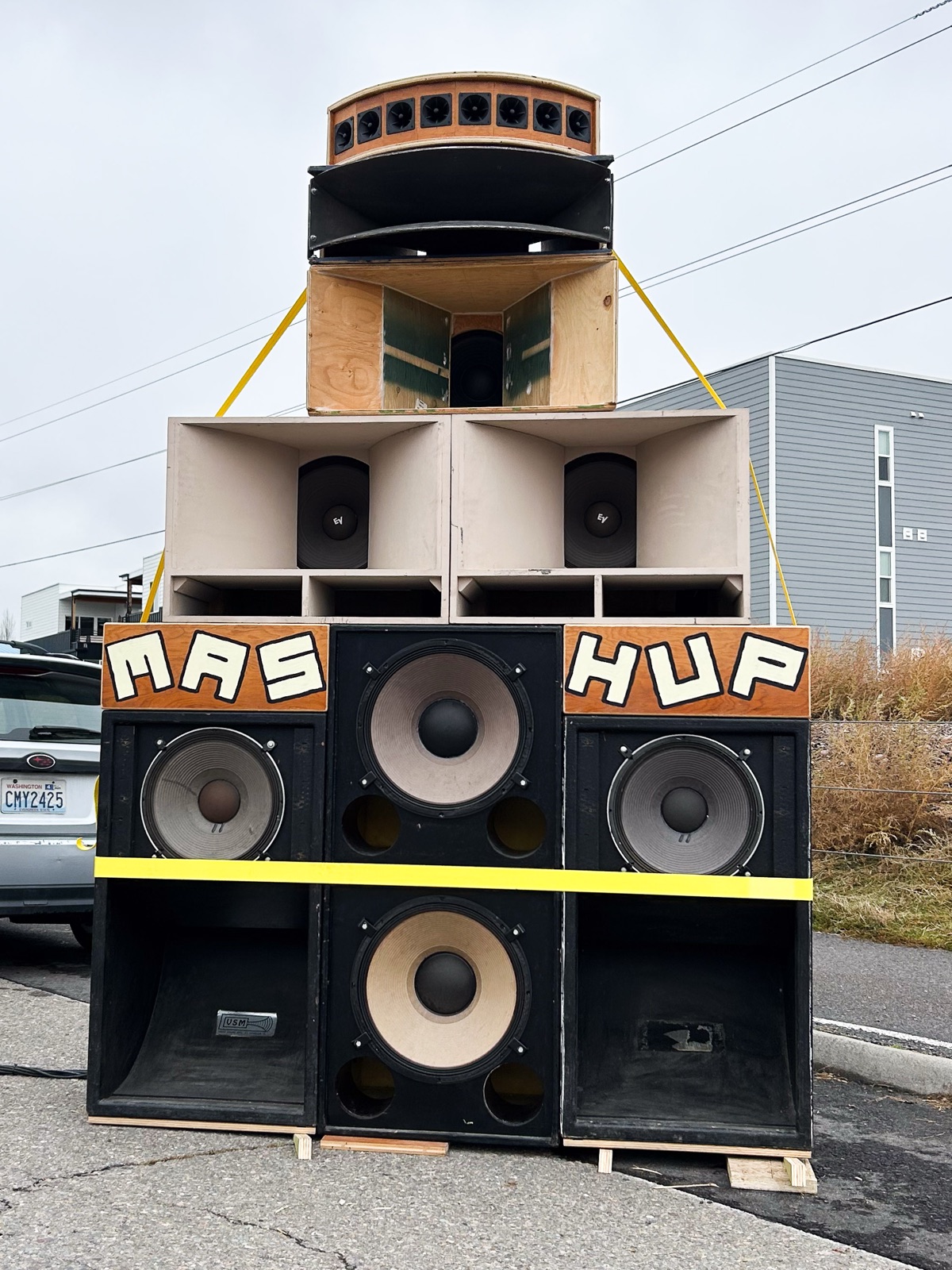
I had the opportunity to look through the wreckage of a large touring soundsystem shop, where much of the good stuff was already gone, but there were a few pieces left. In retrospect it was a bit of a gold mine, but at the time I had no idea what I was looking at. I walked away with a pair of obscenely large JBL horns and a couple of JBL 15" woofers poorly reconed in the 80s. Those pieces were chosen purely by intuition and by how they looked. Fortunately the JBL 2226 woofers and the 2440 compression driver on a 2350 horn are a good fit for what the system would eventually become. I regret leaving a ton of even cooler pieces now that I have researched that stuff and know what I missed. Oh well, the parts have chosen me, not the other way around, so let's go with it.
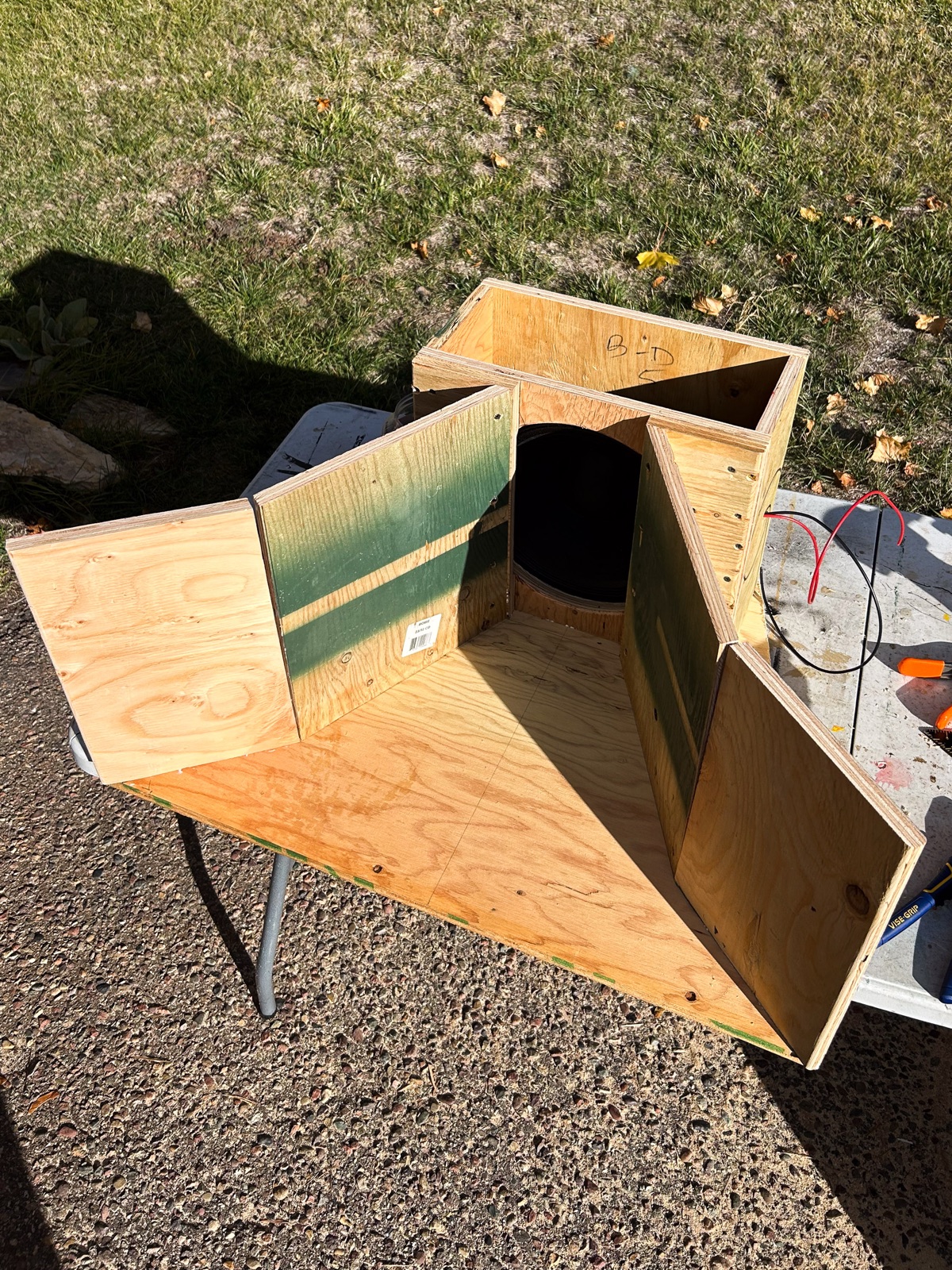
Once I had the scoops and the horn, I needed something in between. The answer was to build a mid horn. I had a Dayton Pro 12" woofer lying around, and spent an afternoon and a few pieces of scavenged plywood building a mid horn. There was no design, I just kinda eyeballed it. The goal was to make it the same footprint as the horn so they could sit as a unit.
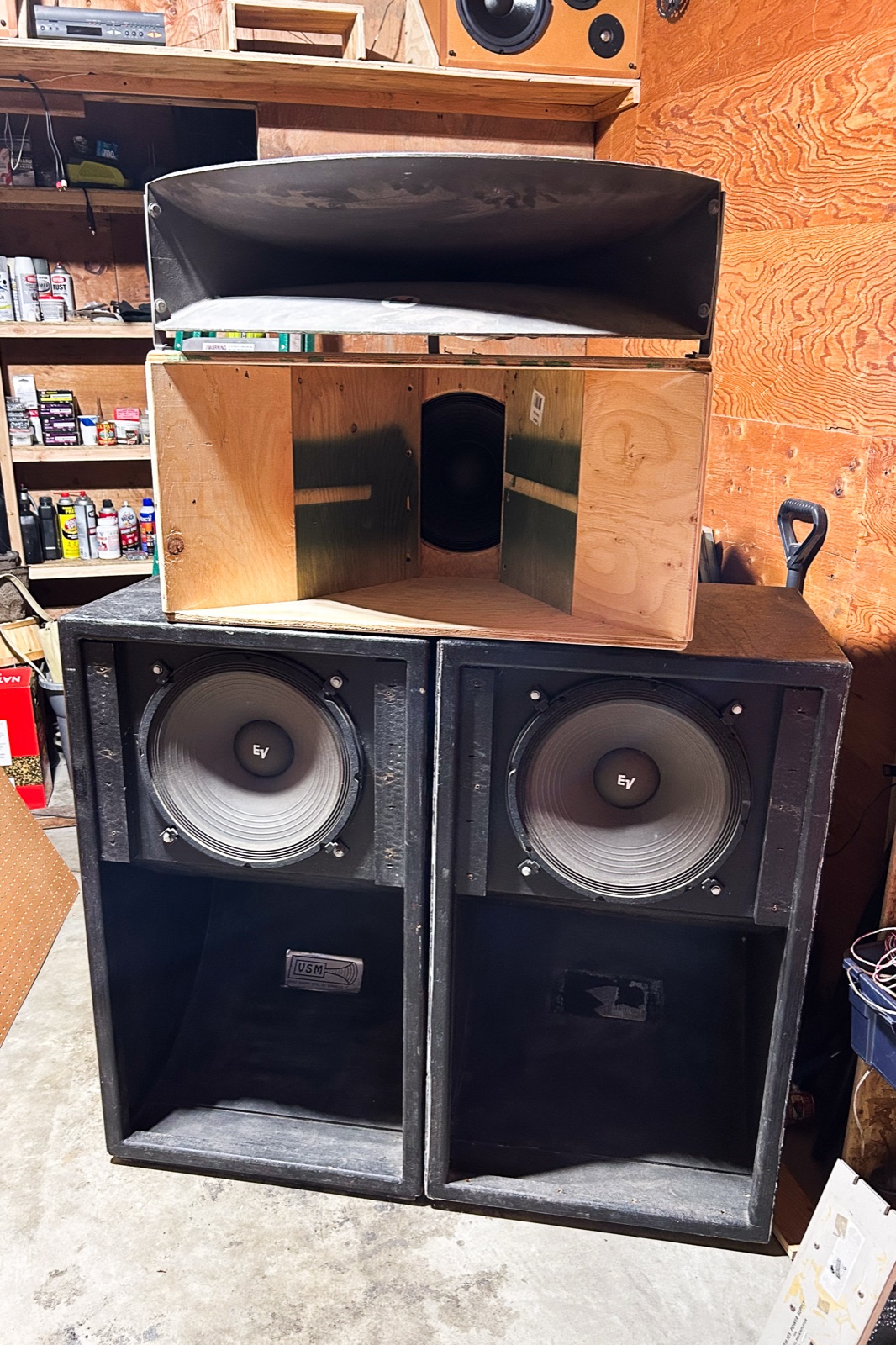
In the depths of Jay's speaker box pile was a pair of Altec 816A cabinets that the JBL 2226s went into perfectly. That was the original core system - scoop bins, a single kick/mid and a horn. Honestly that would have been a reasonable place to stop and call it good, but the problem with a big system is that it can be bigger.
I think I was running the original setup with a miniDSP, which is an incredibly useful piece of gear for the audiophile or speaker builder or anyone trying to cobble things together into something that sounds good.
Tangent - software. The hard part of any speaker is the crossover. Passive crossovers sit at the intersection of science and art. You can design a crossover using the usual calculations, but the results are never quite what you expect and iteration is key. Tuning, whether by ear or by measurement, is always needed and can steal the momentum when you need to buy parts for each version. Fortunately amplifier channels are cheap, and programmable DSP lets you try things at a rapid pace and can do things passive hardware simply can't. Truly a game changer for turning a pile of parts into a speaker system. My analog-biased brain still believes that simpler is better and elegance is the ultimate goal, but sometimes a single digital piece that removes complexity is not just a fair compromise, but the choice that makes the project doable.
The miniDSP was eventually upgraded to a Behringer DCX2496 DSP unit, colloquially called a "drive rack" even though that is the name of the similar rack unit made by dbx. The Behringer has a charming blend of functionality configured via a clunky interface that makes it feel like the future, as seen from Y2K.
The new 4-way setup sounded great and was the first version that sounded like a "real" soundsystem. It played like that for a few months in my garage before I moved into the current studio space. Part of the desire for a studio is the draw to build bigger things. And bigger is exactly what the soundsystem yearned to become.
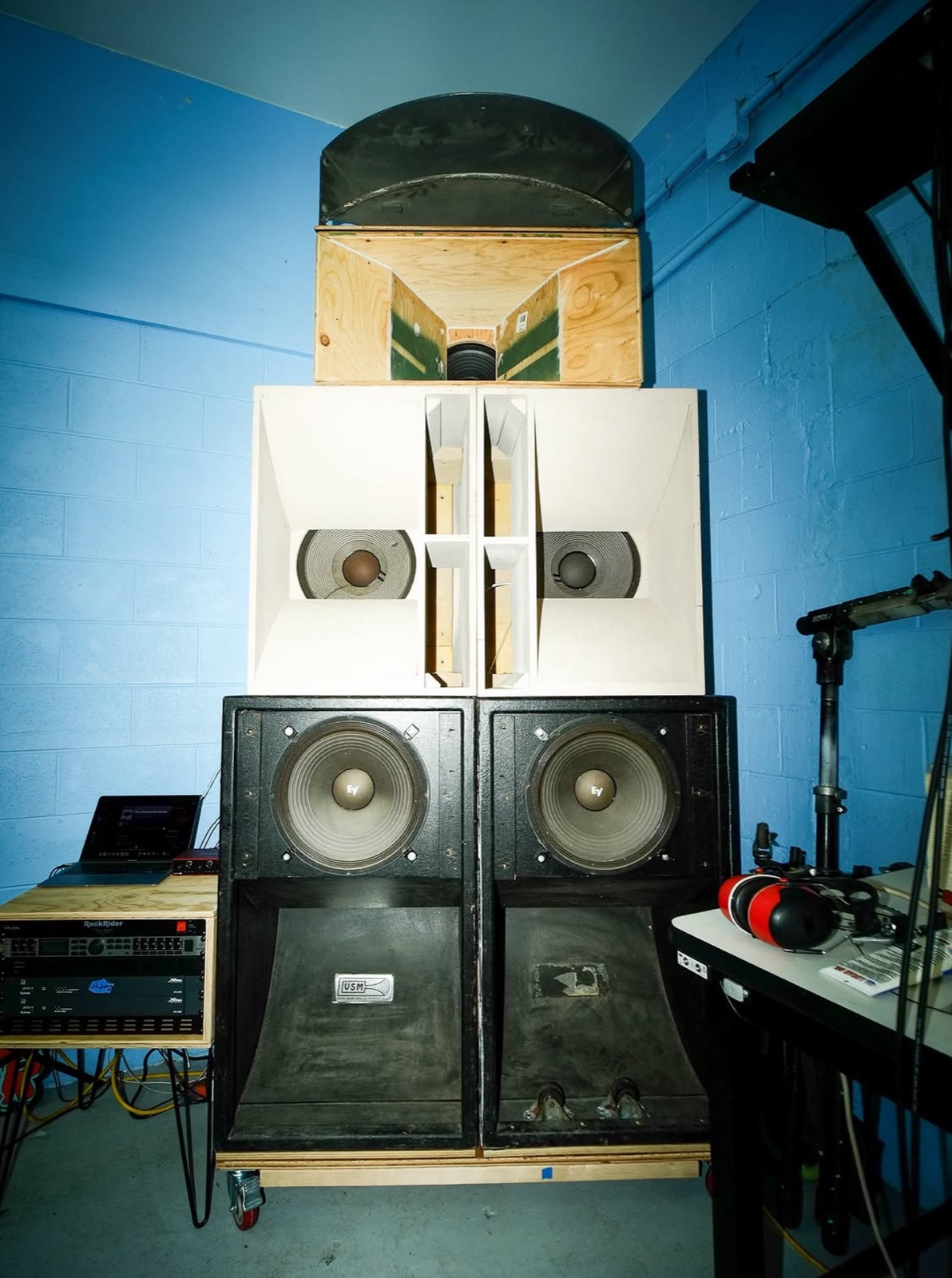
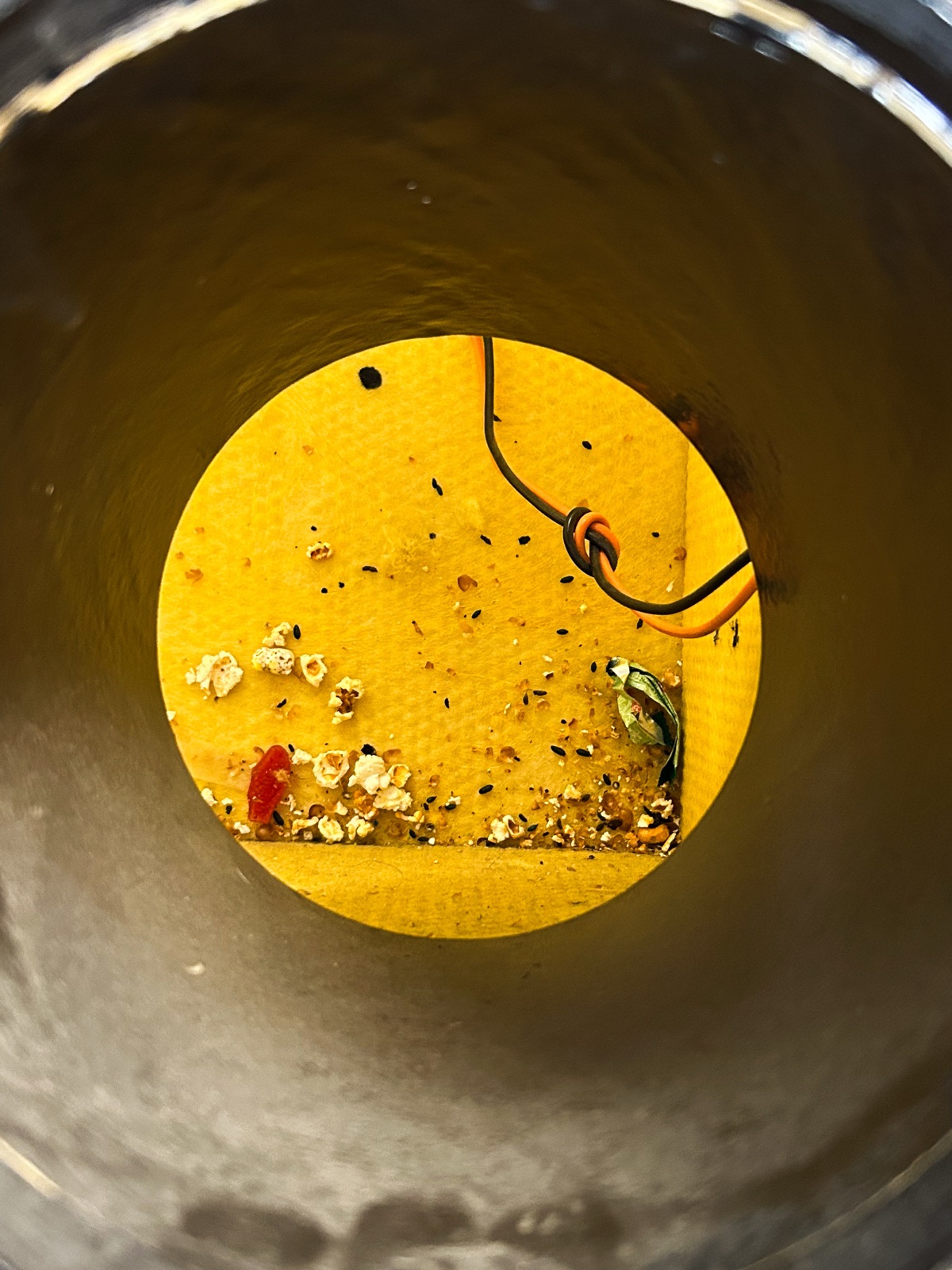
The Roxy Theater in Missoula, Montana is a local institution of culture, entertainment, and triple-organic popcorn. They recently upgraded a soundsystem dating to the 90s, and the leftover amplifiers and subwoofers were looking forward to an active retirement in a soundsystem. I hauled them back to the studio, cleaned the popcorn out of the speaker cabinets, siliconed the speaker cones back together where needed, scraped out the lint-and-butter mixture that clogged every vent and heat sink, and ordered new caps for the ones that were bulging or long since exploded. Trey at Syntron recapped the amplifiers and it was time for upgrades.
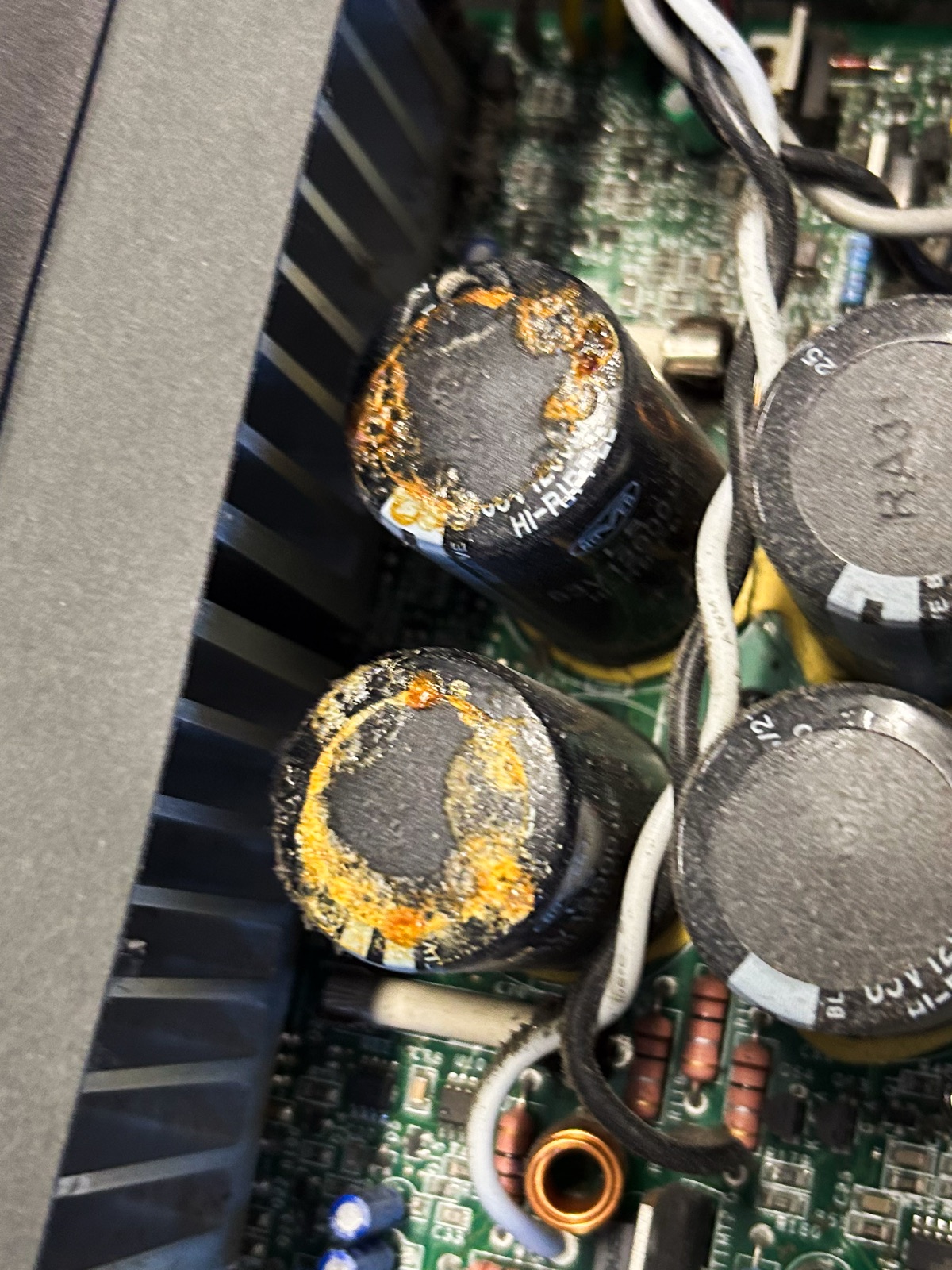
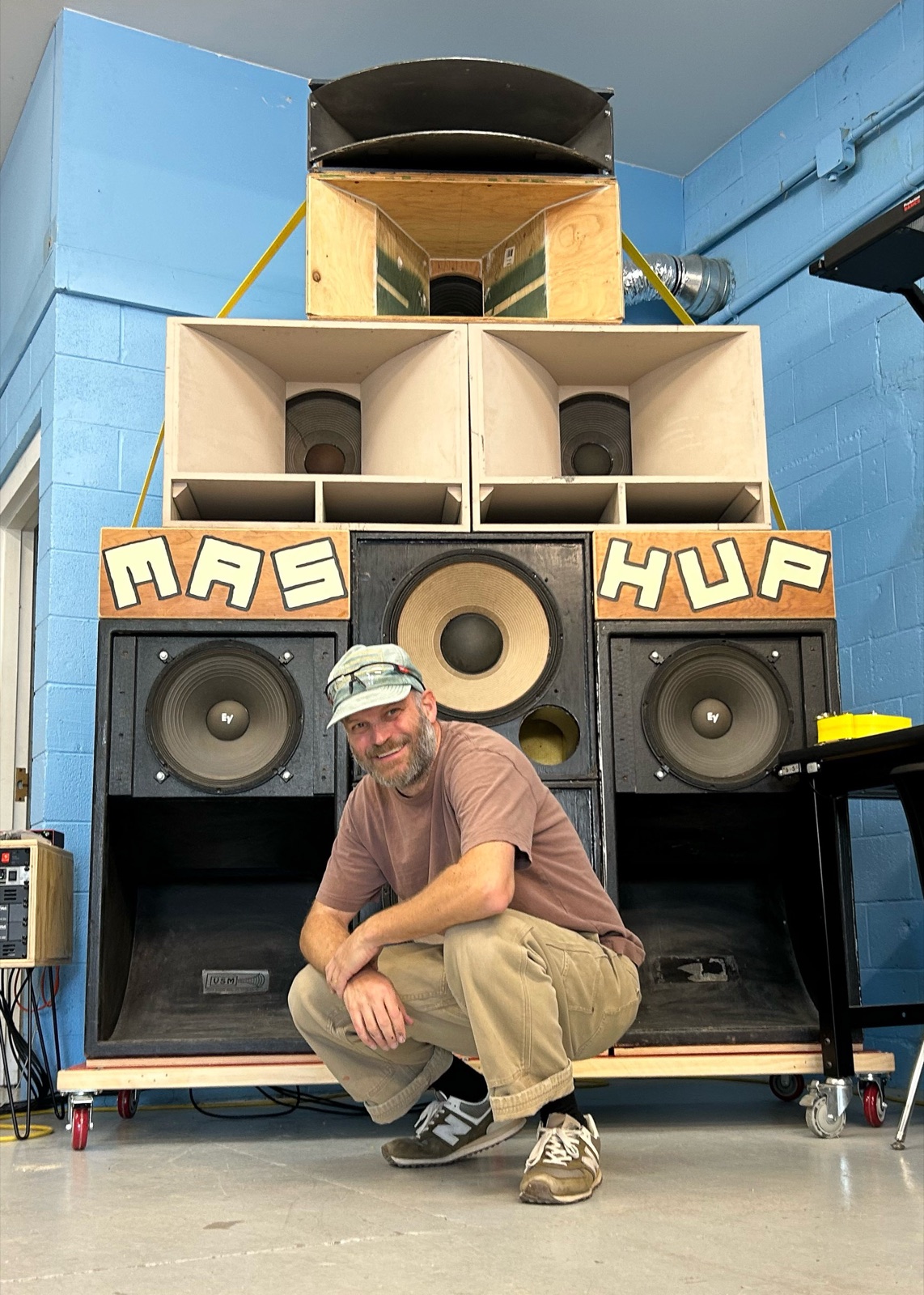
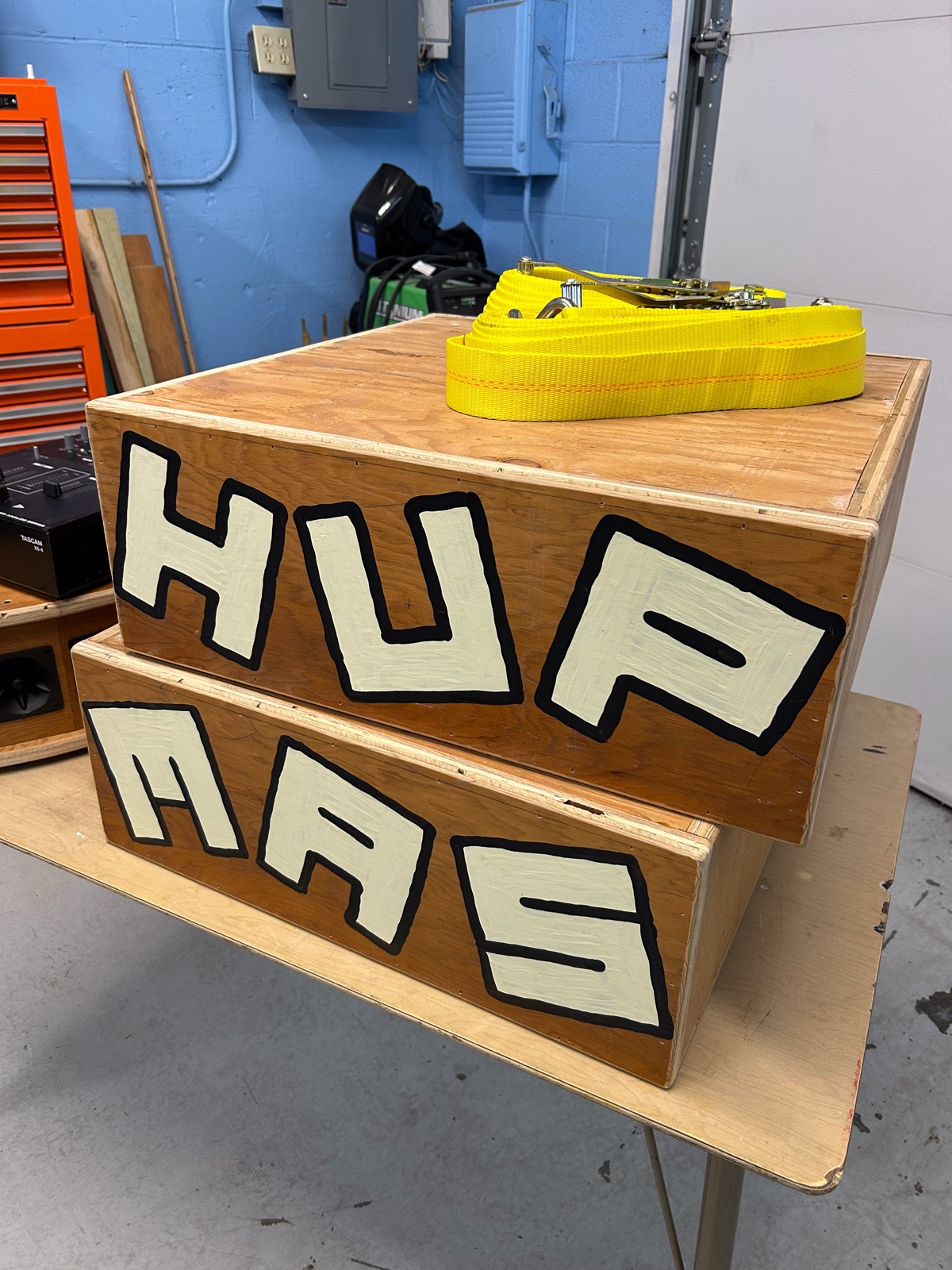
I added the two 18" ported woofers to the center of the stack, flanked by the scoops, and stacked up the amplifiers in a new rack cabinet. The stacked 18" woofers were a bit taller than the scoops, so there was a void that needed filling. I had been contemplating names for the system and Mashup just kinda felt right. It continues the line of Mashup Cycles and Mashup Publishing, and it feels like the soundsystem shares the same bricolage attitude as those projects. Two heavily patina'd, hand-painted plywood boxes fill the gaps and give the system a name.
The last piece left was a piezo crown to add a little air and sparkle where the horn drops off, and to make a clear statement that this is not a serious project even though it sounds good. Piezos are a strange device. They are $3 each, take no power to drive so they don't need another amp channel, and can be easily integrated into a system. With advantages like this they make it into a lot of systems out of sheer practicality. How do they sound? At this point who cares. Also fine. And they are really only playing the top octave, which most people can only hear part of. The curved 8-piezo array was a joy to build and felt like a very sculptural finish to the project.
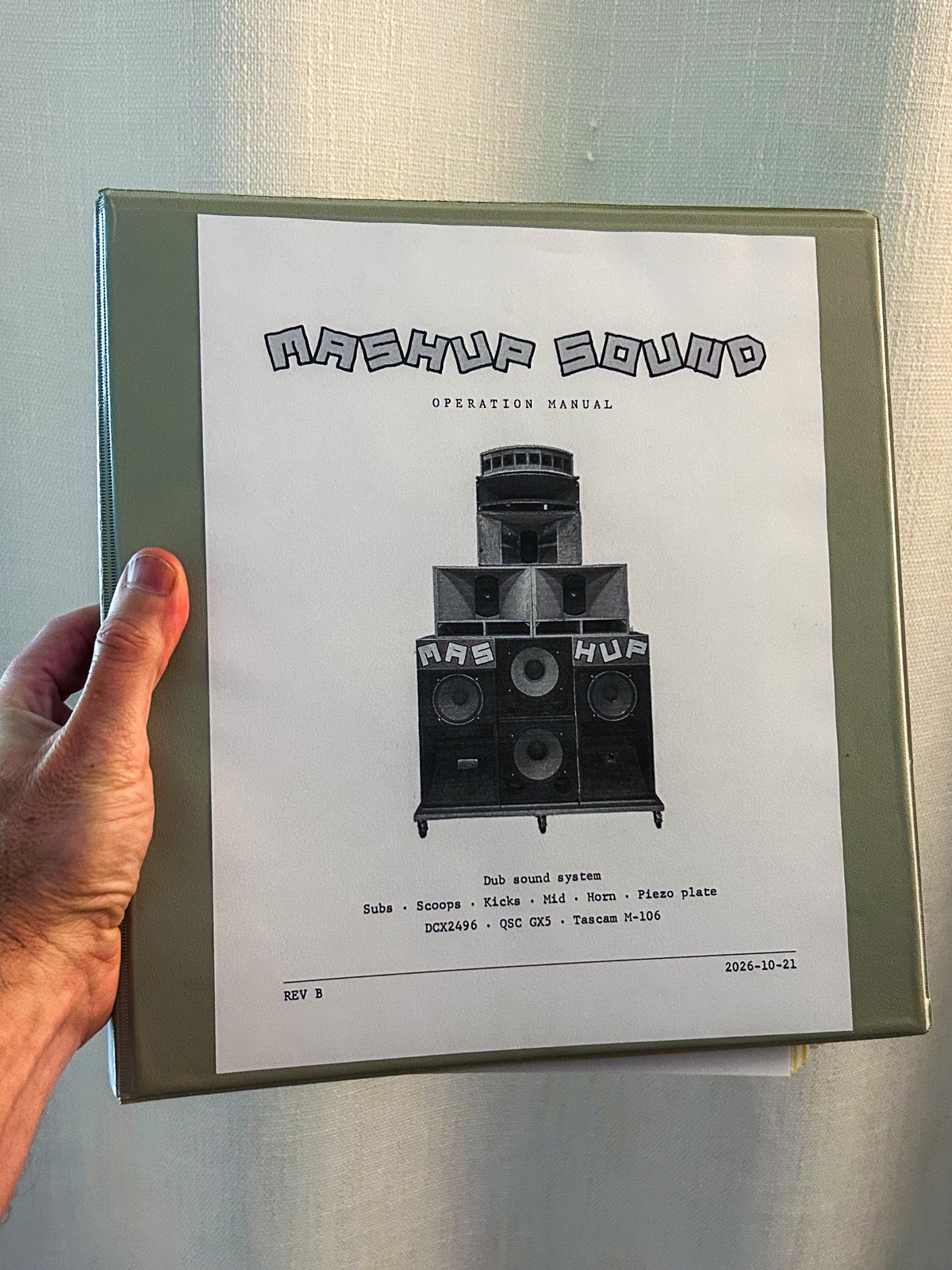
The manual. Vintage gear manuals are such a wealth of information and have such a pure design aesthetic - functionality that reflects the time when it was made. Given that many of the parts in the system originated long before computers and modern publishing, the manuals have a ton of charm. I wanted the system itself to have a manual that reflects that.
The manual borrows heavily from a related project where I am harvesting fonts from typewriters and old pre-computer and early-computer-era documents. The font is from the Prestige Pica 72 type element in my barely-functional IBM Selectric. The manual covers the entire system in detail, with a section for each component and appendices for the datasheets and manuals for everything involved. It is an artifact of the project as well as an actually useful reference manual. There are measured response curves and all settings are documented. There are probably not very many soundsystems that have been documented online to this level of detail. See mashupsound.com for the full details.
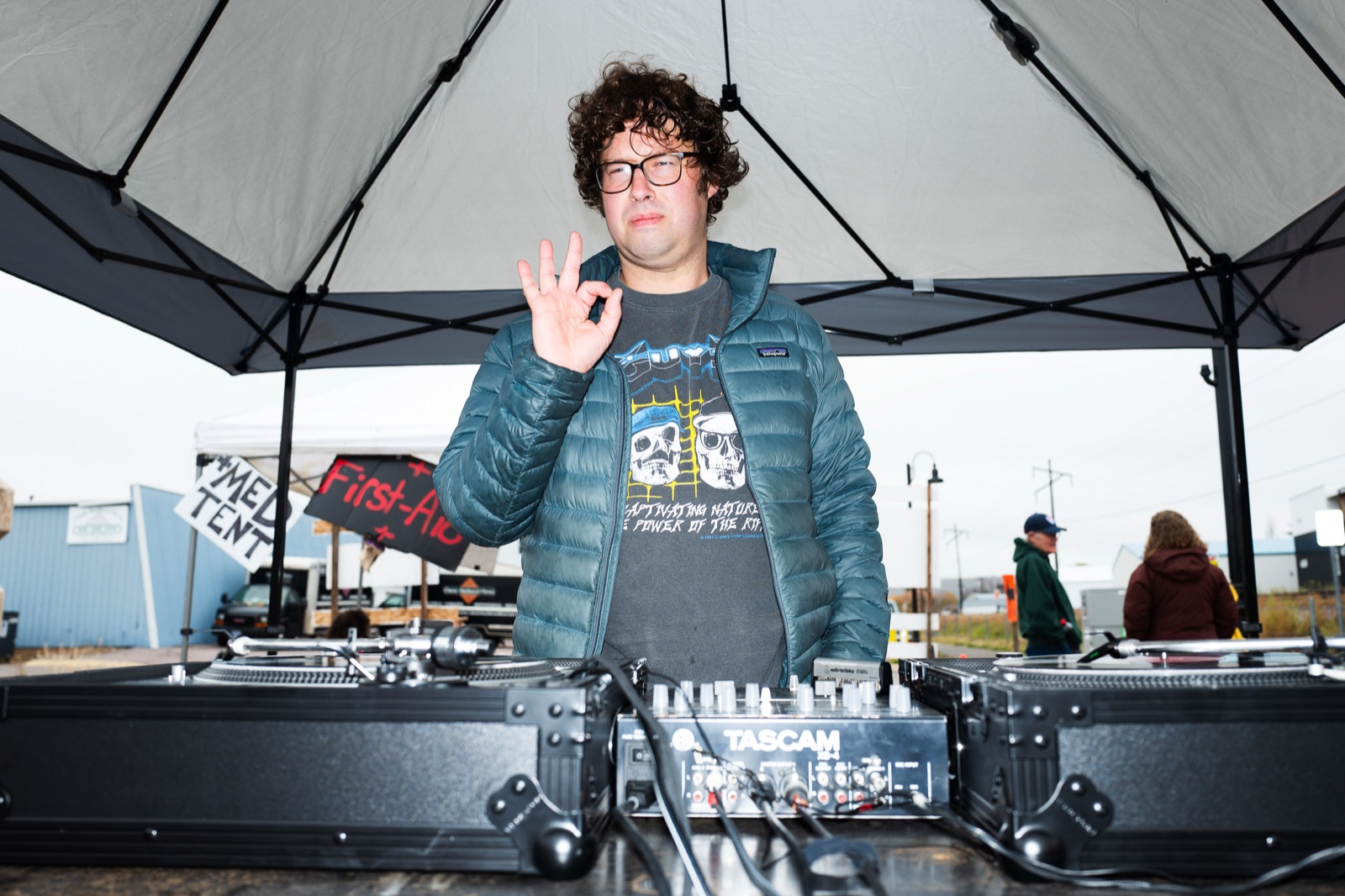
Mashup Sound made its debut on Halloween 2026 at the Ronan Street Block Party and the Industrial Arts Montana launch event. Jesse Brenneman played an all-vinyl set of dub and classic reggae. The system did well, with tons of character and no major issues. One of the scoop drivers has a bit of a buzz when pushed hard, but turning just that channel down a bit helped. There were several soundsystems at the block party and they were all much louder than poor little Mashup, but I like to think it held its own on vintage tone and style alone.
Thanks to Jay, to Trey for the amp recap, Jesse Brenneman for playing through the system, the Roxy Theater, and the Garage Sale Report crew for moral and technical support.